

Where,
 — Pa; the saturation pressure of a pure substance. In the case of liquid-vapor equilibrium or phase change, it refers to the vapor pressure at the boiling point;
 — K; the boiling point temperature of a pure substance;
 — J/mol; heat of vaporization;
 — m³/mol;specific volume change for the vaporization, in other words, the specific volume difference between vapor and liquid:
  。
。
In the Clapeyron equation (eq. 1), the molar heat of vaporization, , is always positive, as heat is always applied to boil liquid into vapor. The specific volume difference between vapor and liquid during the vaporization process is also always positive, as vapor occupies a larger volume per mole than liquid does before the critical point (distillation cannot operate at or beyond the critical point). Additionally, in the absolute temperature scale of Kelvin, the temperature is always positive. Hence, the ratio on the right-hand side of the Clapeyron differential equation is always positive. In other words,
dPsat / dT > 0 and dT / dPsat > 0 for all Psat and T
This means thermodynamically, for all substances, higher pressures always lead to higher boiling point temperatures, and vice versa.
The monotonicity of the vapor-pressure-to-boiling-point-temperature function in the case of water is illustrated in Figure 1.
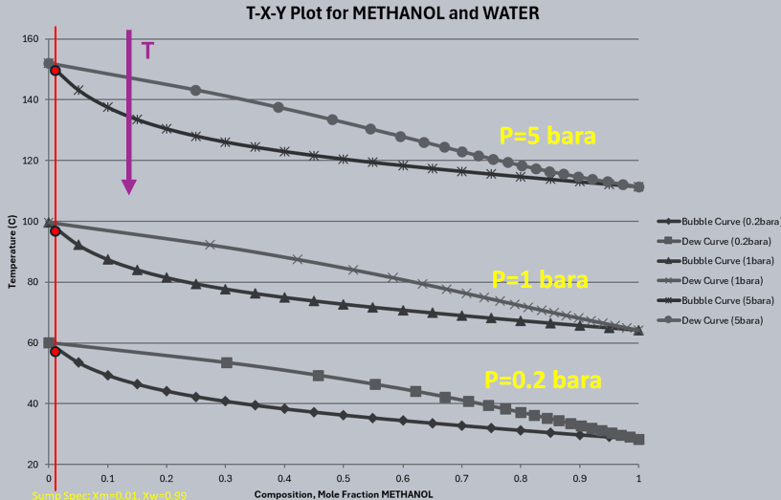
In actual distillation practices, the author has noticed that even though process engineers know that lowering operating pressure lowers the sump temperature, sometimes, they are not alerted to the fact that the boiling point reduction is more pronounced in vacuum towers than in higher-pressure towers. An earlier Bernoulli-chem article has explained this by evaluating the ratio of (dT/dPsat)/P (Bernoulli-Chem, 2026). An example is that for the same pressure reduction of 1 bar, the boiling point of water is reduced by almost 100 °C at around 1 atm, while only a less-than-10 °C-reduction is achieved at around 5 bara (Figure 1). In vacuum towers, since the top pressure is only tens of kPa, the pressure-drop across the column becomes significant in the resulting bottom pressure and therefore, the sump temperature.

For an open system such as a distillation column, streams of different compositions enter and exit the system , thus changing the compositions in either liquid or vapor. This compositional change for an open system will be taken into account by the composition set  for each component. The proof centers on the Gibbs energy, whose mathematical beauty lies in that its natural variables are strictly in temperature (T), pressure (P), and composition (
 ).The engineeringly less favored parameters such as entropy (S) and volume (V) are no longer the independent variables but are actually functions of T, P, and the composition (which are favored because they can be practically measured via field instruments).
Inside a distillation column, when the operation reaches equilibrium, resulting in stable T, P, and the compositionsin both the liquid and vapor phases at any column height or stage, the molar Gibbs energy at any instant may be expressed as a function of G = f (T, P, ).The multivariable differential with respect to T, P, and each component i’s molar fraction may be taken one by one while holding others constant:

Where,
G — J/mol; the molar Gibbs energy at any stage in a distillation column at any moment. The notation of underbar means “per mole”;
P — Pa; the operating pressure at the stage in the distillation column. It is also the vapor pressure for a distillation column reaching phase equilibrium;
T — K; the temperature at the stage in the distillation column;
— -; the collection of molar fractions of all the components  . at the stage at any moment in the distillation column. Usually, the molar fraction notation
  is used to describe the liquid phase, and
 for the vapor phase;
k, i, j — -; subscripts denoting a certain component;
C —-; the number of components in the mixture;。
The seemingly complicated third term in eq. A1.1( ), , simply represents taking the partial derivative of G with respect to each molar fraction
 , while holding T, P, and all other component j’s constant. Then, these partial derivatives are added across all C components.
Eq. A1.1 is the fundamental thermodynamic equation of the total Gibbs energy. By working from the1st law and the 2nd law of thermodynamics, it may be proven that (Sandler, 2006). Thus, the fundamental Gibbs equation becomes:

 — J/(K·mol); the molar entropy at any stage in the distillation column;
 — m³/mol; the molar volume at any stage in the distillation column;
To express each component i’s share of the thermodynamic property, the partial molar identity is defined as:



A separate counter k is employed in Eq. A1.3, because i here is no longer the summation counter but the targeted species.
Using the equilibrium condition  (Appendix 2) on Eq. A1.3 gives:

Note that the vapor-phase Gibbs energy equation is not expanded because at bubble point, no simple treatment of the summation of  is available. The mathematical trick is to relate the fundamental Gibbs energy equation of the liquid phase to the Gibbs-Duhem equation of the vapor phase (Appendix 3). Therefore, based on Eq. A1.4, multiplying all sides of the equations by the vapor-phase mole fraction,
Therefore, based on Eq. A1.4, multiplying all sides of the equations by the vapor-phase mole fraction, , of component i at the bubble point condition gives:

Take the summation over all components on Eq. A1.5 to create the term,  , , which is the left-hand side of the Gibbs-Duhem expression:

While the last double summation term in Eq. A1.6 looks formidable, the proof targets the question of whether lowering P lowers T for any given bubble point composition. In other words, the composition is constant. In a distillation column, this may be interpreted as each stage having a composition specification. For example, a product specification of 0.1 mol% light key (or 99.9 mol% purity for the heavy key in a binary mixture) for the column bottom. As the tower pressure changes, operation-wise, the sump temperature is supposedly adjusted to keep the old mixture composition. Not doing so risks either reduced product purity (more light components going into the sump liquid) or increased product loss (more product losing into the vapor phase). A fixed composition , therefore, leads to
  = 0, Consequently, the double summation
  nets to 0. The resulting equation is:

; At a given bubble point composition  — (Eq. A1.7)

; at — (Eq. A1.8)

; at — (Eq. A1.9)
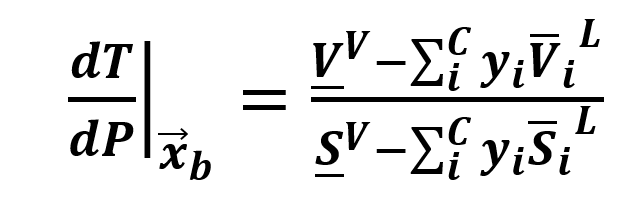
The ratio in Eq. A1.10 needs to be examined for positive or negative values, so as to determine the sign of dT/dP. The difficulty lies in the interpretation of and
and  . At first glance, the summation of partial molar liquid-phase properties (
 and
and  ) multiplied by the corresponding vapor mole fractions (
 ) means nothing thermodynamically. However, Eq. A1.10 can be rewritten by using
 and
and  (ID. A1.2):

 and
and  suggest the volume and the entropy differences when one mole of the equilibrium vapor is taken from the coexisting liquid. Mathematically, they represent the vaporization properties of the transferring mass:


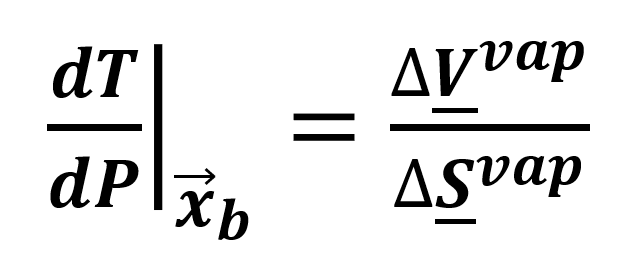
Since below the critical point, vapor is the lower-density phase, the molar volume change is always positive during the vaporization process, or >0 . Similarly, since heat is physically required during the vaporization process to liberate vapor molecules from the liquid matrix, by
 , whereis the heat of vaporization,
  > 0. Therefore, dT/dP and dP/dT are always positive.


For any homogeneous system, the molar Gibbs energy is a thermodynamic potential expressed in temperature (T), pressure (P), and the mole fractions  . From the 1st law and the 2nd law of thermodynamics, the fundamental Gibbs energy equation is (Sandler, 2006):

Where,
G — J/mol; the molar Gibbs energy of the system. The underbar notation means “per mole”;
P — Pa; the pressure of the system;
T — K; the temperature of the system;
z — – ; the collection of molar fractions of all the components {Zi} of the system;
S — J/(K·mol) ; the molar entropy of the system;
V — m³/mol; the molar volume of the system;
Ḡi — J/mol; the partial molar Gibbs energy of component i. Defined as the partial differential of the molar Gibbs energy with respect to species i’s molar fraction  , while holding T, P, and other components
  constant, or
 . The industry commonly calls it the chemical potential with the notation
  .
.
Besides the fundamental Gibbs energy equation, the molar Gibbs energy may also be expressed as the summed partial molar Gibbs energy for each component i weighted by the mole fraction :
 — (Eq. A3.2)
The general product rule holds true in calculus for any differentiable functions f(x) and g(x) with respect to any independent variable x:
 — (Eq. A3.3)
Applying the differential chain rule to the molar Gibbs energy of Eq. A3.2:
 — (Eq. A3.4)
Equating the Gibbs energy differentials in Eq. A3.4 and Eq. A3.1:

Cancelling out  on both sides of the equation gives


1 The reason  may be written in a fundamental Gibbs energy equation as the molar Gibbs energy,
 , may be proven by calculus. This article skips the math work.