
Clausius-Clapeyron Tells You That Your Column’s Pressure Drop Truly Matters
When I just started my job working on distillation column design, my senior engineer told me:” Mind the pressure drop. A 100-mbar increase in column DP would cause the sump temperature to go up for about 2 °C.” I noted this rule of thumb and was ever since obsessed with it. In my work dealing with petrochemical columns, I found this rule reasonably good for a quick estimate, although more rigorous values should always be calculated in simulation software. However, as my design work moved into downstream industries such as pharmaceuticals, I could not help but find that a 100-mbar DP often gives much higher rises in sump temperatures than 2 °C.
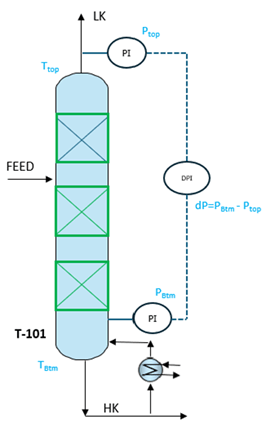
But why do these distillation columns in the downstream industries such pharma, pesticides, fine chemicals etc. tend to have much higher temperature rises than the rule of thumb my senior engineer told me? In other words, why do they show higher sensitivity in temperature rises from pressure increases, or dT/dP? A simple mathematical construction can well explain.
We have the rigorous Clapeyron Equation (eq.1) derived from the Gibbs-Duham equation (the derivation is out of this essay’s scope. Sandler(2006)[1]has a rigorous proof). Just take it as the starting point:
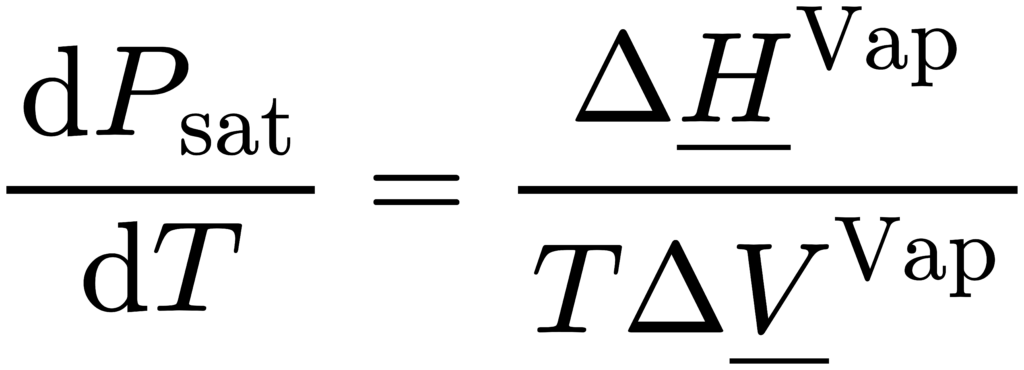
——(eq. 1)
Where,
Pˢᵃᵗ : Pa; the vapor pressure/saturation pressure of a pure substance;
T: K; the boiling point temperature of a pure substance;
ΔHᵛᵃᵖ : J/mol; heat of vaporization;
ΔVᵛᵃᵖ : m³/mol; specific volume change for the vaporization, in other words, the specific volume difference between vapor and liquid:ΔVᵛᵃᵖ = Vⱽ − Vᴸ ;
For most liquids, the volume of the original liquid is negligible compared to the massive vapor volume to which it evaporates. Therefore, ΔVᵛᵃᵖ ≈ Vⱽ . becomes just the specific volume of the vapor.
Then a gas law can be used to express the vapor volume . The easiest is the ideal gas law, which is a decent estimate for most systems at vacuum to low pressures, even if the substance might not exhibit ideal behaviors. Therefore, Vⱽ = RT / P, where R is the universal gas constant 8.314 J/(mol K). The Clapeyron equation then becomes the famous Clausius-Clapeyron equation (eq.2) that many learned in sophomore year back in college:
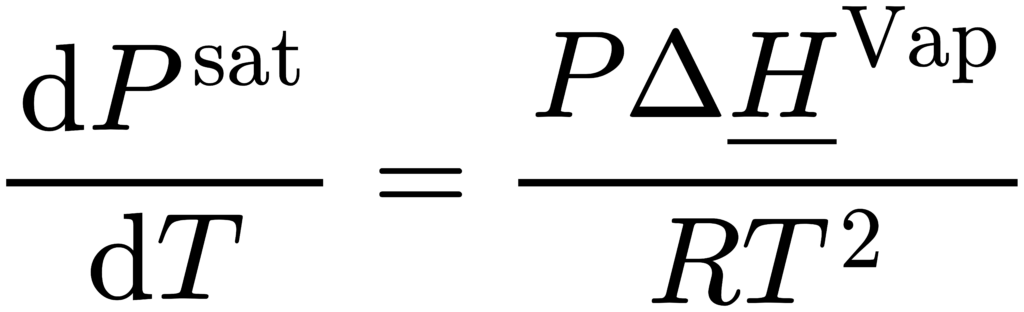
—— (eq. 2)
or
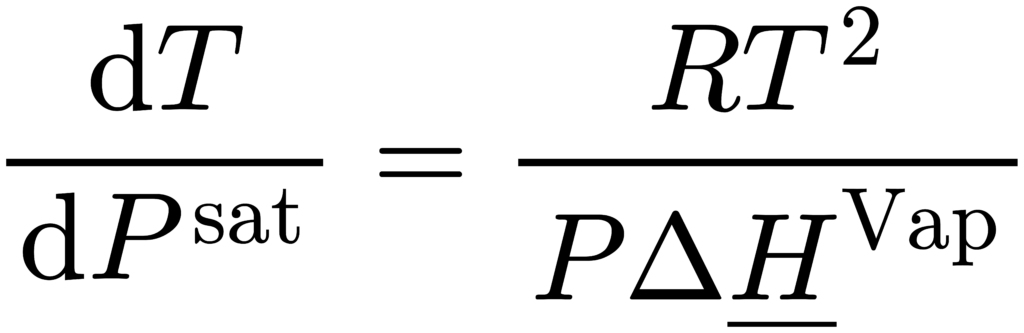
—— (eq. 3)
Note that to analyze the change of temperature with respect to the change of pressure, or dT/dP, the equation (eq.3) is inverted.
A typical distillation scenario involves a binary separation of two keys, a light key (LK) and a heavy key (HK). The column top yields high-purity LK, while the bottom sump gives the corresponding high-purity HK (See Fig 1). Because the sump has almost pure HK (for example, 99.9%wt) and a distillation column operates along the Vapor-Liquid Equilibrium (VLE) curve, the Clausius-Clapeyron equation, which relates a pure substance’s vapor pressure to its boiling point temperature, can be fully applied. And the HK’s vapor pressure, Psat, equals the sump pressure, Pbtm.
Many towers in the industry operate at atm and have water as the almost pure bottom heavy (HK), for example, a tower that separates methanol from water. Using 100 °C (which needs to be converted to 373.15 K) as the approximate sump temperature and taking water’s heat of vaporization, , at 40 kJ/mol, the inverted Clausius-Clapeyron equation (eq. 3) can be used to calculate dT/dP =2.8 K/100 mbar. This is to say, for aqueous/organic systems operating near atmospheric pressure, the 2 °C-for-every-100 mbar-DP rule approximately holds, especially if the pressure is slightly positive, say at 1.5 bara.
For columns that operate at higher pressures, the dT/dP sensitivity decreases significantly. For example, an EO purification column separates EO and water. As a typical industry practice, the column’s top pressure, PTop, is set at about 3.7 bara. The pressure drop for a full-trayed column is about 500 mbar, which corresponds to a column sump pressure, Pbtm, of 4.2 bara, and the resulted bubble point temperature (almost pure water) of 146 °C. When the design is changed from full tray to mostly packing in a new installation, the pressure drop is reduced to less than 150 mbar across the column. And the sump pressure is reduced to about 3.8 bara. When the plant started running, the TI instrument gave a sump temperature at 142 °C. This actual field observation agrees with the inverted Clausius-Clapeyron (eq. 3) calculation: dT/dP = 1 °C/100 mbar.
The single most significant parameter in the inverted Clausius-Clapeyron equation (eq. 3) is the pressure. Double the pressure almost halves dT/dP. Similarly, halving the pressure into vacuum doubles the sensitivity of sump temperature to pressure increase. This is exactly why in high pressure distillations like those of ethylene or propylene towers, pressure drops are not the key focus, but in vacuum distillations, the pressure drops can result in sump temperature increases higher than one might expect, even easily surpassing the thermal degradation temperature.
Below is a table that summarizes the factors that affect the temperature sensitivity to pressure drops, or dT/dP:
Parameter | Effect to dT/dP | Comments |
Operating Pressure | Lower P => higher dT/dP Higher P => lower dT/dP | Almost invertly proportional |
Operating Temp. | Lower T => lower dT/dP Higher T => Higher dT/dP | T in absolute (K) |
HK’s | Lower => higher dT/dP Higher => lower dT/dP | Heat of vaporization at system temperature |
If one of your columns operates at 0.5 bara vacuum, about 160 °C, and a heat of vaporization lower than water’s, your column will have a much higher sump temperature increase than the 2°C-rule my senior engineer once told me, probably in the range of 8-10 °C. This is to say, a 100 mbar (10 kPa) column pressure drop would lead to a sump temperature of 168-170 °C, no longer the originally specified 160 °C.
As a result, in these cases, low-dP column packings and internals (including your support grids, liquid collectors, and distributors) are much preferred. In the special case of corrosive substance distillation, try SiC packing for much lower DPs while for even higher separation efficiencies!
References:
[1] Sandler, S. I. (2006). Chemical, biochemical, and engineering thermodynamics (4th ed.). John Wiley & Sons.
Note: Sandler (2006)[1]provides a rigorous derivation of the Clapeyron equation starting from the Gibbs–Duhem equation.